
CDEP Purpose, Description and Implementation
The TRIBE intervention purpose is to serve foster, and system impacted African American youth and adults affected by trauma, post-traumatic stress disorder (PTSD), and complex PTSD (C-PTSD). TRIBE recognizes complex trauma and complex PTSD as having significant and widespread societal and long-term health impacts devastating for African Americans who have been or remain at risk of being institutionalized. TRIBE’s focus on trauma is fundamental, where the behavior of AA youth and adults has been pathologized and criminalized rather than recognized as normal-to-be expected trauma responses.

The population (communities) served by the CDEP are African American adults who are returning citizens and male youth who are system and/or gang impacted.
A strategy used to incorporate cultural knowledge into the design of TRIBE TRIBE’s intervention relies on its innovative K-TECTT (Know Thyself Embodied Complex Trauma Therapy) modality. It draws on neuroscience research to combine somatic and brain-based learning techniques integrated with African and African American cultural knowledge. This therapeutic mode of treatment through content and physical activity informs TRIBE’s programmatic program that involves increasing 37 protective factors along with discharging trauma from the body. TRIBE’s socioecological approach validates the whole person and helps him or her to build confidence in their own resilience.
The CDEP goal is to heal trauma by reframing ethnic identity and experience, and create new mental models and world views.
CDEP components/activities include….
Healing Circles – Added circles focused on gang-involved and gang-impacted trauma, where elders and peers support self-regulation, initiation into healthy manhood/adulthood, and collective healing.
Know Thyself Resilience Workshops – Core identity and culture curriculum using African and African American history and worldview to rebuild accurate, pride-based identity and resilience.
Somatic HipHopHeals – Somatic trauma-healing work using Hip Hop, movement, strength training, and boxing to release trauma stored in the body and calm the nervous system.
Emotional Intelligence – Affective regulation and emotional skills (reading emotions in the body, understanding triggers, moving from reacting to responding) to reduce criminalized trauma behaviors and stabilize functioning.
Conflict Resolution – Communication and collaborative problem-solving skills for managing conflict in relationships, school, work, and community, including active listening and nonviolent communication.
Entrepreneurship and Wealth Building / Abundance – Multi-week entrepreneurship and financial literacy sequence that reframes wealth as abundance and guides participants to build licit income streams and business plans.
The TRIBE environment that creates a family that is a permanent support system, shared experience with mentors and coaches, safe space consisting of 20,000 Sq.Ft. 24/7 Youth Development Center, peer mentorship, youth leadership, and youth owned clothing line business
Evaluation Research, Design and Methods
Evaluation Design
Single-group pre/post design aligned with an 8–12 week developmental intervention.
Methods tailored to trauma-informed, community-based programming.
Data collection
2018-2026: Quantitative data collected through 13 psychosocial instruments
Qualitative data included one word descriptors, one sentence descriptors, thematic elements, and key informant interviews which also incorporated cultural knowledge.
Scale
1,009 enrolled participants, 508 program completions
High community staff representation (90% local; most with lived experience)
Credibility Signal: Strong fidelity monitoring and mixed-method triangulations strengthen confidence in findings.
Results: Quantitative
YOUTH LOCAL EVALUATION
Key Takeaways
The cultural, practical, and theoretical significance of these findings lies in the demonstrated relationship between trauma-informed treatment, positive ethnic identity development, and reductions in aggression and gang involvement. The results support the premise that behaviors among Black youth, frequently subject to criminalization, may instead reflect normative trauma responses. Structural racism has produced systemic neighborhood disinvestment and widespread family disruption through mass incarceration, which often removes fathers from the household. Within these contexts, engagement in criminalized activities can emerge as both an economic necessity and a means of expressing normative adolescent risk-taking behaviors in the absence of safe, structured recreational alternatives.
Key Findings
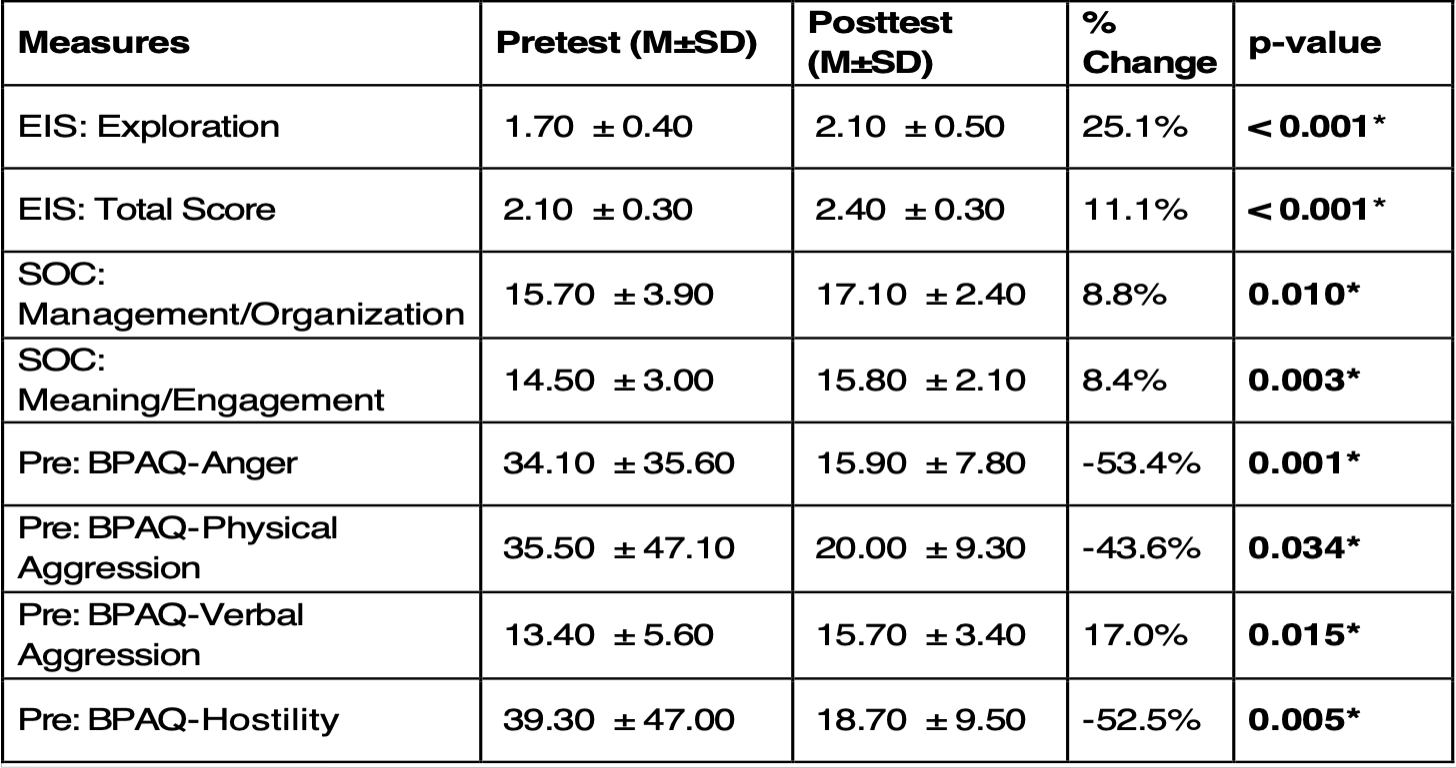
Significant Identity Growth: There were significant increases in EIS: Exploration (p<0.001), indicating that participants advanced significantly in their identity development process.
Behavioral Reductions: All aggression related measures (BPAQ-Anger, Physical Aggression and Hostility) showed Statistically significantly decreases in posttest. Notably, BPAQ-Verbal showed a slight increase.
Social and Meaningful Engagement: Significant improvements were observed in SOC: Management/Organization (p=0.010) and SOC: Meaning/Engagement (p=0.003), indicating improved organizational skills and a stronger sense of purpose post-intervention.
Youth SWE Results: Statistical Significance (\alpha=0.05):
Statistically significant positive changes (meaning a reduction in negative feelings) were found for Nervous (p=0.015), Depression (p=0.009), Everything Takes Effort (p=0.004), and Worthless (p=0.028).
The change for Hopeless (p=0.091) and Restless (p=0.108) was not statistically significant at a=0.05 but indicates a trend towards a reduction in these feelings.
Results: Qualitative
ADULT LOCAL EVALUATION
Transformation
Psychological Transformation
Key Insight: Participants experienced meaningful psychological healing across multiple validated domains.
Highlights
PTSD likelihood reduced (49.8% → 37.7%)
Depression prevalence reduced (39.5% → 29.6%)
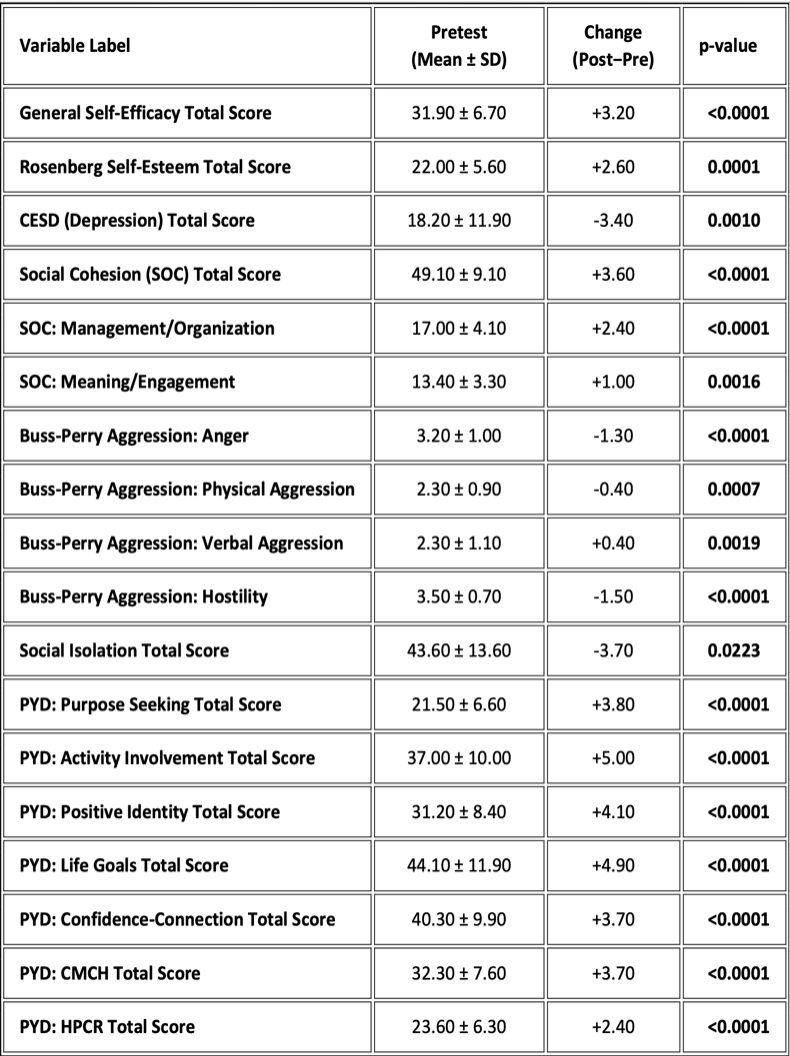
Resilience and self-efficacy increased significantly
Low self-esteem cut by more than half
Executive Takeaway: TRIBE functions as an effective early intervention for complex trauma.
Behavioral & Cultural Transformation
Key Insight: Participants moved from dysregulation and marginalization toward identity stability and cultural pride.
Observed Changes
Significant reductions in physical aggression, hostility, and anger
Decreased feelings of isolation and societal exclusion
Strengthened cultural identity through African-centered learning
Why It Matters: Healing occurred not only internally, but socially and culturally—key to long-term stability.